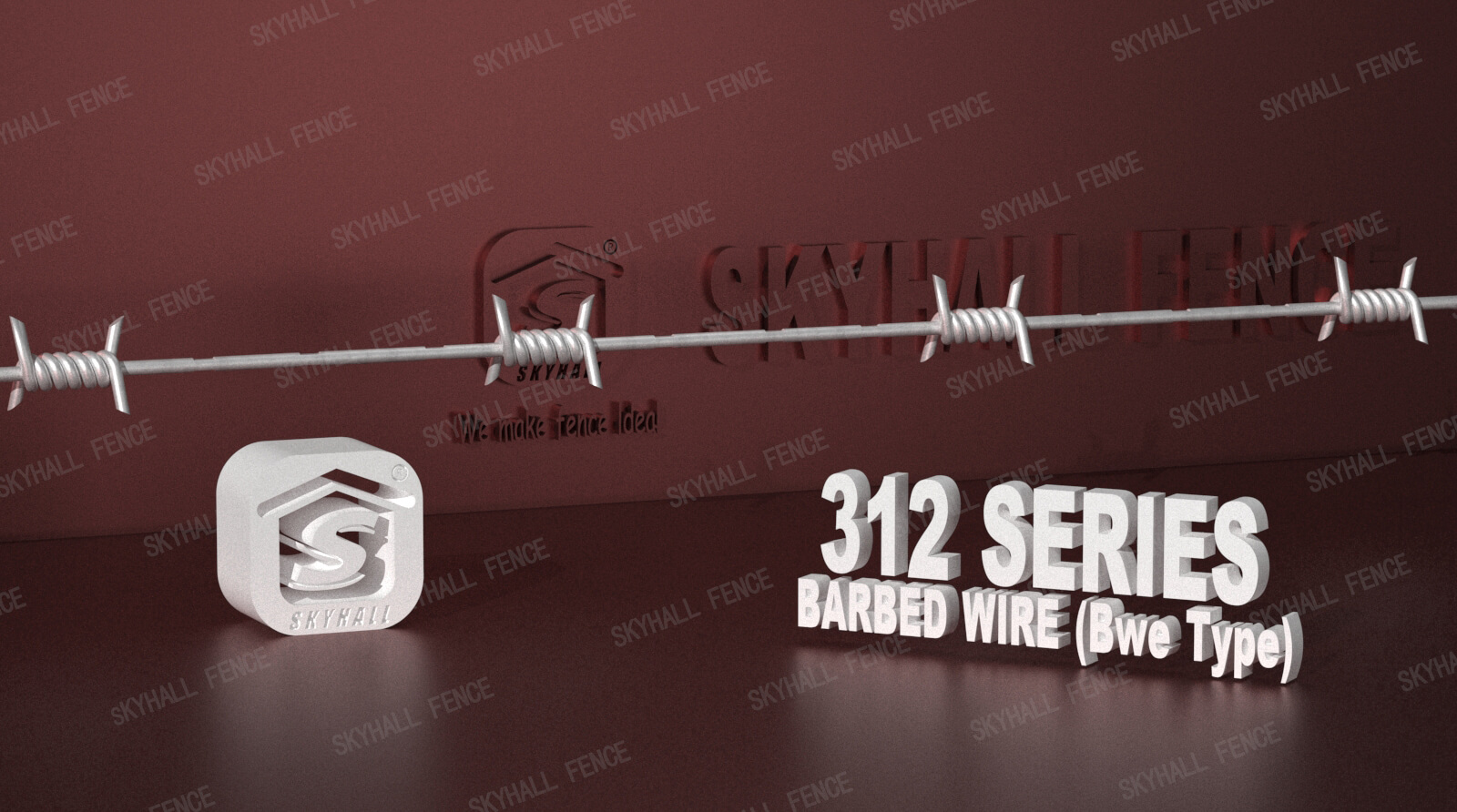
The barbed wire BWE type from SKYHALL® Fence is produced from a single strand of low carbon or high carbon steel wire. That’s why we also call it single strand barbed wire. It’s surrounded by four-point barbs twisted by double strands of barb wires arranged at a certain distance.
Processed by pre hot dipped galvanized treatment, the single-strand barbed wires are as durable as traditional barbed wires. They are commonly used to secure perimeters and create fencing in some restricted areas.
Economical and durable, our BWE type barbed wires are highly praised by customers all over the world.

Price index:

Reference Colors:

Function:

Application:

BWE Single Strand Barbed Wire is usually used for
| Line Wire Diameter | Tensile Strength | Barb Wire Diameter | Tensile Strength | Barb Spacing | Surface Treatment |
| 3.0 | 1250 | 2.0 | 350 | 60 | Galvanized |
| 2.5 | 1250 | 2.0 | 350 |
Wide Application
The barbed wire BWE is economical and easy to install on any surface, thus preferred by farmers and ranchers for cattle and bison use. Besides, they are adaptable for diverse fencing needs to upgrade the perimeter security. You can combine them with various fences for different uses. Besides single-strand barbed wires, you also have other selections to strengthen the protection, such as razor wires, double-strand barbed wires, and spikes.
High Protection
There are four-point barbs surrounding the single strand barbed wire at certain distances. These sharp points make barbed wires hard to cross through, thus preventing intruders effectively and providing high protection to the territory targeted.
Durable and Low Maintenance
Our BWE type barbed wire is pre hot dipped galvanized, which means there is a layer of zinc on the wire to make it resistant to corrosion and rust. This helps your fence last longer and maintained less.
Surface Treatment
BWE barbed wires are pre hot dipped galvanized to fight against corrosion and provide longer service. Some customers may prefer stainless steel barbed wire to get higher corrosion-resistant performance. Both galvanized steel barbed wire and stainless steel barbed wire are perfect choices for harsh environments.
Barbs are usually twisted around the core wire with a space of 4 to 6 inches.
Absolutely. You may select stainless steel single barbed wire. It’s corrosion resistance is even better than that made from carbon steel wire and treated with zinc coating layer.
This versatile barbed wire enables you to use it in many scenarios:
You can take the following instruction as a reference.
We have a variety of barbed wires for customers to meet their different needs, including traditional barbed wire, reverse twist barbed wire, single-strand barbed wire, concertina barbed wire, etc. You may contact our sales team for details to prepare for your projects.
We will provide the latest progress of your orders at the earliest by way of. Just make a registration on our website and you will get all the updates from your private account.
Cost-Effective: It is one of the most affordable fencing options per foot.
Easy to Install: Lighter and easier to handle and tension than multiple-strand or woven wire fences.
Highly Visible Deterrent: The barbs provide a clear psychological and physical barrier.
Long-Lasting: When made from galvanized steel, it offers excellent resistance to rust and corrosion.
Flexible: It can be easily added to existing fence structures.
Barbed wire is commonly available in two gauges:
12.5 Gauge: This is the standard and most common thickness, offering a good balance of strength and flexibility.
15.5 Gauge: A lighter, thinner gauge used for more temporary or low-budget applications.
The line wire is typically 12.5ga or 15.5ga, while the barb wire itself is usually a thinner 14ga.
T-Posts (Steel Posts): Very common. Barbed wire is attached using wire clips or metal ties.
Wooden Posts: A classic choice. The wire is stapled directly to the post.
Angle Iron Posts: Used for high-strength, permanent corners and end posts.
Concrete Posts: For permanent installations in corrosive environments.
Crucially, you must use very strong bracing on corner and end posts to handle the high tension of the wire.